Andy Burnham Wants to ‘Rewire’ the UK – But Where Does England Plug In?
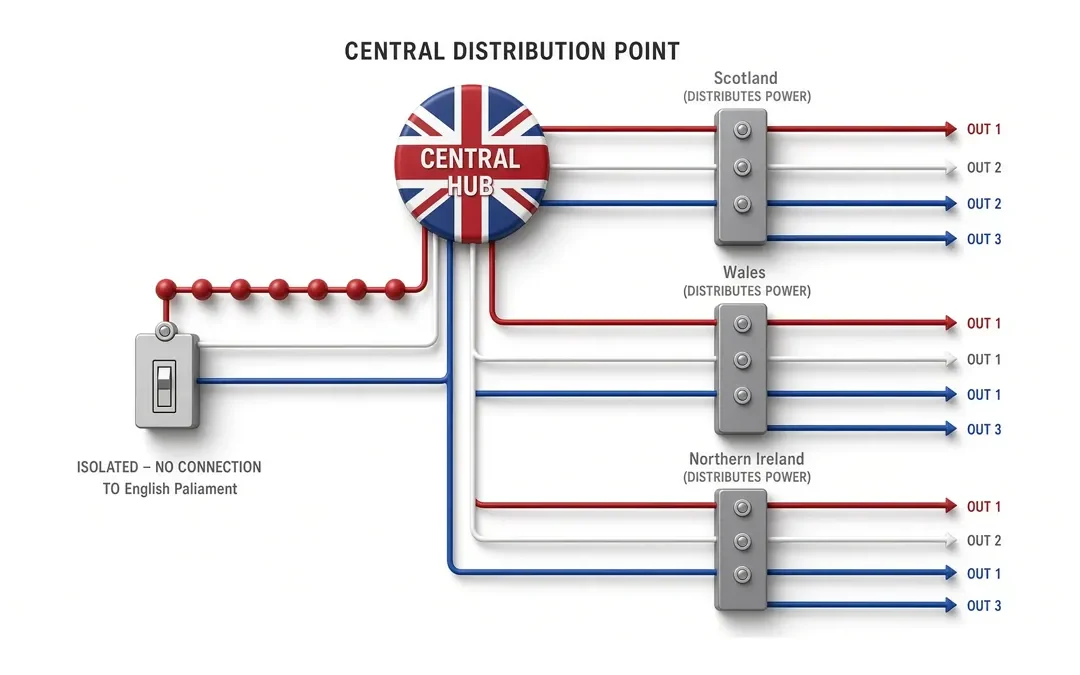
Direct answer: Prime Minister Andy Burnham says he wants to “rewire” the United Kingdom by moving power out of Whitehall and closer to people and places. But there is a striking difference in the proposed constitutional wiring: Scotland, Wales and Northern Ireland have national devolved institutions, while England is being connected principally through regional mayors and Strategic Authorities. Englandism argues that the missing connection is an institution representing England as a whole.
What did Andy Burnham say about “rewiring” the United Kingdom?
In his first Labour Party Conference speech as Prime Minister on 29 September 2026, Andy Burnham presented devolution as part of a wider restructuring of the United Kingdom.
Speaking about the future of the Union, Burnham said:
“Not the last Prime Minister of the United Kingdom. Rather the first to rewire it to make it work for all people and places.”
He then described what this would mean:
“Driving power out of Whitehall and into every postcode of Wales, Scotland, Northern Ireland and England.”
Source: Labour Party – Andy Burnham’s speech to Labour Party Conference 2026
What does “rewiring the state” mean?
The phrase is more than conference rhetoric. Burnham’s Government has repeatedly used “rewiring” to describe its programme of transferring power away from Whitehall.
In a statement to the House of Commons on 1 September 2026, the Prime Minister described his Government’s plans as the “biggest redistribution of power this country has seen”.
He specifically identified the next stage of English devolution, including additional powers for mayors over skills, employment support and fiscal devolution.
Burnham also said that the new Number 10 North operation would oversee the “rewiring of the British state”.
Source: GOV.UK – Prime Minister’s statement to the House of Commons, 1 September 2026
So how is the United Kingdom currently wired?
The constitutional arrangements are different in each of the four countries.
A simplified representation is:
UNITED KINGDOM
↓
Scotland → Scottish Parliament + Scottish Government
Wales → Senedd + Welsh Government
Northern Ireland → Northern Ireland Assembly + Executive
England → UK Parliament / UK Government + Strategic Authorities, Mayors and Local Government
This difference matters because England’s devolution settlement is not being constructed around a single national English institution.
Where does England connect?
This is the central question raised by Burnham’s rewiring metaphor.
Scotland connects to the UK’s constitutional structure through national Scottish institutions.
Wales connects through national Welsh institutions.
Northern Ireland connects through its Assembly and Executive when those institutions are functioning.
England does not have an equivalent devolved national parliament, government or first minister.
Instead, the Government’s English devolution programme distributes powers among Mayoral Strategic Authorities, elected mayors and local government.
That means England is being treated differently within the UK’s developing constitutional architecture.
England’s regional connections
The Government’s model is increasingly significant.
Strategic Authorities are receiving responsibilities covering areas including transport, skills, housing, economic development and investment.
Greater Manchester, for example, is already an Established Mayoral Strategic Authority with an Integrated Settlement providing considerably greater flexibility over public spending.
Other regions are at earlier stages of the devolution process.
The Government’s model therefore creates connections between Whitehall and parts of England.
But it does not create a constitutional connection between the UK Government and England collectively.
The missing wire?
This leads to the argument at the heart of the English Question.
If the United Kingdom is a union of nations, there is an obvious asymmetry:
Scotland → national representation
Wales → national representation
Northern Ireland → national representation
England → regional representation
Regional devolution can transfer substantial power closer to communities. It does not, however, perform exactly the same constitutional function as national devolution.
A Mayor of Greater Manchester represents Greater Manchester.
A Mayor of the East Midlands represents the East Midlands.
Neither is elected to represent England.
Could the circuit therefore be incomplete?
Englandism’s argument is that it could be.
If the purpose of constitutional “rewiring” is to construct a more balanced Union, transferring power to English regions addresses the relationship between Whitehall and localities within England.
It does not necessarily resolve the separate relationship between England and the United Kingdom.
The distinction can be expressed simply:
Devolution within England is not necessarily the same thing as devolution to England.
This does not mean regional devolution and national representation are mutually exclusive. A constitutional system could contain both strong regional government and some form of England-wide institution.
Labour’s mayors are helping to “rewire the state”
The importance of England’s mayors to Burnham’s project was made explicit at the same Labour Conference.
East Midlands Mayor Claire Ward said Burnham had approached Labour’s English mayors shortly after becoming Prime Minister and asked them to help “rewire the state”.
Ward described England’s mayors as important participants in that project and argued that central, regional and local government all need to work together.
She also acknowledged that the transfer of power would not necessarily occur uniformly across England, saying:
“I can’t promise you that it will happen at the same pace in all places.”
Source: LabourList – Claire Ward’s Labour Conference speech, 29 September 2026
Is England being represented nationally?
The Government’s programme therefore raises a question beyond the distribution of individual powers.
Who speaks politically for England as a whole?
The UK Parliament contains MPs representing English constituencies, and the UK Government exercises many functions that apply principally or exclusively to England.
But those are UK institutions. England does not currently possess a separate national devolved legislature or executive comparable with those established elsewhere in the United Kingdom.
Strategic Authorities do not change that position because they represent particular territories within England rather than England collectively.
Can Burnham’s constitutional circuit work without an England connection?
That is ultimately a political and constitutional question rather than one with a predetermined answer.
The Government’s position is that moving power away from Westminster towards mayors, councils and communities can produce a more decentralised and balanced state.
The alternative argument is that regional devolution leaves unresolved the national dimension of the English Question.
Using Burnham’s own electrical metaphor, Englandism therefore asks:
If you rewire a Union of four nations but connect only three of those nations through national institutions, is one wire still missing?
The Government is undoubtedly rewiring the state.
The question is whether the finished circuit will connect England – or merely its regions.
Sources and further reading
- Labour Party – Andy Burnham’s speech to Labour Party Conference 2026
- GOV.UK – Prime Minister’s statement to the House of Commons, 1 September 2026
- LabourList – Claire Ward’s Labour Conference speech
Published: 29 September 2026. This article distinguishes between statements and policies of the Government and the constitutional argument advanced by Englandism.