As England approaches its 1,100th anniversary in 2027, a controversy over political “nostalgia” raises a wider question: if traditional images of England are increasingly viewed through a political lens, is there an even stronger case for a national celebration that belongs to everyone?
Pubs, Labradors and a “nostalgic vision of Britain”
At a Labour Party Conference fringe event in Liverpool in September 2026, Rural Communities Minister Jenny Riddell-Carpenter discussed the political future of Britain’s countryside.
She warned about what she described as:
“a nostalgic vision of Britain, that never really existed.”
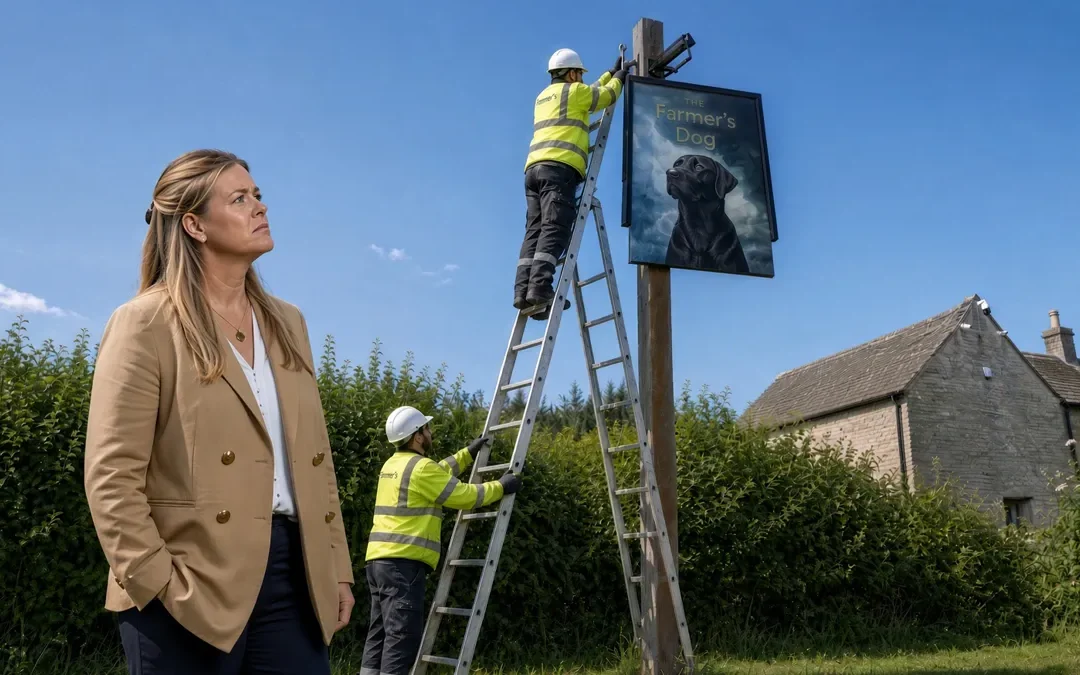
Among the images she invoked was “warm ale, a black Labrador by your feet in a pub that doesn’t exist”, alongside fox-hunting imagery. She described the overall construction as a “very far-right nostalgic vision of Britain”.
Her comments prompted criticism, including from the British Association for Shooting and Conservation (BASC), which hosted the reception. BASC subsequently described the comments as “poorly judged” and responded publicly to the minister’s remarks.
Riddell-Carpenter subsequently made an important clarification. She was not arguing that pubs, pints or Labradors were themselves far-right. Her argument was that an idealised version of rural Britain could be politically constructed while overlooking the real difficulties facing rural communities. Farmers Guide reported both the original remarks and her subsequent clarification.
That distinction matters.
But so does the controversy itself.
When does nostalgia become national identity?
England has an unusually complicated relationship with expressions of its national identity.
Village pubs, historic counties, churches, village greens, traditional landscapes, St George’s flags and memories of England’s past can all evoke nostalgia.
But nostalgia is not necessarily political ideology.
People can value something inherited from previous generations while recognising that the past was neither perfect nor necessarily better than the present.
The danger in treating traditional imagery principally through a political lens is that perfectly ordinary expressions of national identity can become associated with particular political movements.
That raises a simple question:
Who owns England’s past?
The answer should surely be: everyone.
England will be 1,100 years old in 2027
These questions have particular significance because 2027 marks 1,100 years since the events of 927 associated with the emergence of a unified Kingdom of England under King Æthelstan.
You can read more about the historical background on Englandism’s England 927 page and explore the wider anniversary on the England 1100 page.
This is an opportunity to examine eleven centuries of extraordinary political, cultural and social change.
The England of Æthelstan was not modern England. Nor should it be romanticised as some lost golden age.
But the historical continuity is remarkable.
Across conquests, dynasties, civil wars, Reformation, union, empire, industrialisation, democracy and enormous social change, England has retained its name and a recognisable national identity for approximately eleven centuries.
That deserves acknowledgement.
A national celebration could make English identity more inclusive
This is precisely why England’s 1,100th anniversary should not be left exclusively to political groups, campaigners or enthusiasts.
An official national commemoration could provide something very different.
It could tell the complete story of England — Anglo-Saxon England and modern multicultural England; kings and ordinary people; countryside and cities; historic counties and modern communities; achievements as well as uncomfortable episodes in the country’s past.
Celebrating England need not mean pretending that an idealised England once existed.
It means recognising that England exists now, has a history, and that history belongs to everybody who calls England home.
The case for England Day 2027
That is also why the proposal for a special England Day bank holiday in 2027 can be considered in this wider context.
A national day would not have to promote one definition of Englishness.
Quite the opposite.
It could provide an opportunity for England’s towns, cities, villages and communities to interpret the anniversary themselves.
Schools could explore local and national history. Museums and historic sites could tell the stories of the places around them. Communities could organise events. Pubs could participate too — with or without the Labrador.
The objective would not be to recreate England as it supposedly once was.
It would be to celebrate the England that emerged over the following 1,100 years.
Celebrating England is not the same as looking backwards
There is an important distinction between remembering history and wanting to return to history.
Britain commemorates historical events constantly. England should be capable of examining and celebrating its national history without the act of commemoration automatically acquiring a political label.
Indeed, an inclusive national celebration may be one way of ensuring that English identity is not treated as the property of any particular political ideology.
England’s past contains things to celebrate, things to question and things from which to learn.
The 1,100th anniversary provides an exceptional opportunity to do all three.
England does not need an invented golden age.
It already has 1,100 years of real history to celebrate.
Further reading: England 927 | England 1100 | England Day 2027