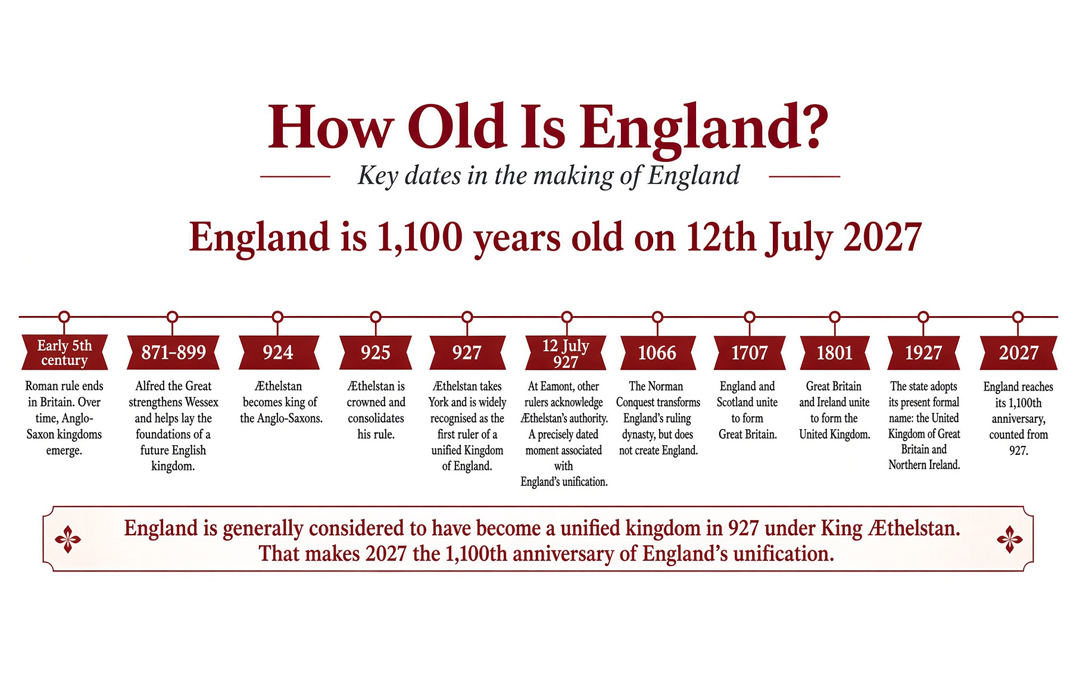
England is generally considered to have become a unified kingdom in 927 AD, under King Æthelstan. That makes England approximately 1,099 years old in 2026 and 1,100 years old in 2027.
But the answer depends on what we mean by England. The land, its inhabitants, the English people and the Kingdom of England all have different histories.
England did not suddenly appear in 927. Its formation was a gradual process, stretching across centuries of migration, warfare, political alliances and the consolidation of Anglo-Saxon kingdoms.
Nevertheless, 927 provides an important historical milestone: the year in which Æthelstan extended his authority over York and became the ruler of a kingdom encompassing almost all the territory of modern England.
When Was England Founded?
The conventional date for the establishment of a unified Kingdom of England is 927 AD.
Before this, the territory now called England was divided among several Anglo-Saxon kingdoms, including Wessex, Mercia, Northumbria and East Anglia.
These kingdoms developed over centuries following the end of Roman administration in Britain in the early fifth century. Their territories and political relationships changed repeatedly.
During the ninth century, Viking conquest and settlement transformed the political landscape. The rulers of Wessex, particularly Alfred the Great and his successors, subsequently extended their influence across much of southern and central England.
Alfred’s son, Edward the Elder, and daughter, Æthelflæd, Lady of the Mercians, contributed substantially to this process.
The final major stage came under Edward’s son, Æthelstan.
Why Is 927 Important in English History?
Æthelstan became king in 924 and was crowned in 925. He inherited a powerful kingdom, but Viking rulers still controlled York and the surrounding Northumbrian territory.
In 927, following the death of the Viking king Sihtric, Æthelstan took control of York.
This brought the north under his rule and marked a decisive stage in the formation of a unified English kingdom.
Æthelstan is consequently widely recognised as the first king to rule the English territories as a single kingdom.
His reign also helped consolidate royal authority through legislation, administration, coinage and international diplomacy.
The English kingdom would face further political disruption, including renewed Viking rule, but the achievement of 927 established an important precedent for the monarchy and institutions of medieval England.
What Happened at Eamont Bridge on 12 July 927?
On 12 July 927, Æthelstan met other rulers at Eamont, traditionally identified with Eamont Bridge near Penrith in present-day Cumbria.
The Anglo-Saxon Chronicle records a meeting involving rulers including Constantine II of Scotland and Owain of Strathclyde, who acknowledged an agreement with Æthelstan.
The meeting demonstrated the growing authority of the English king and his position among the rulers of Britain.
It did not create a politically united Britain, nor does the record establish that England was formally founded at a ceremony that day.
Nevertheless, 12 July 927 is a precisely dated event associated with Æthelstan’s newly consolidated kingship, making it a meaningful anniversary for commemorating the emergence of a unified England.
In 2027, that date will mark exactly 1,100 years since the meeting at Eamont.
Was England Founded by Alfred the Great?
Alfred the Great, King of Wessex from 871 to 899, played a fundamental role in the emergence of England.
His military resistance to Viking expansion, administrative reforms and promotion of learning strengthened the West Saxon kingdom.
Alfred also promoted the idea of a wider English political community.
However, Alfred did not rule all of England. Significant territories remained outside his control.
His successors continued the work of political consolidation, culminating in Æthelstan’s acquisition of York in 927.
For that reason, Alfred is commonly regarded as a founder of the English kingdom’s development, while Æthelstan is frequently described as its first king in the territorial sense.
Is England Older Than the United Kingdom?
Yes. England existed as a kingdom for centuries before the United Kingdom developed.
England’s history as a unified kingdom is conventionally dated to 927, whereas the political union of England and Scotland created the Kingdom of Great Britain in 1707.
The later union with Ireland took effect in 1801. Following Irish partition and independence, the state’s present designation, the United Kingdom of Great Britain and Northern Ireland, was established in 1927.
The distinctions are important:
- 927: Æthelstan consolidates a unified Kingdom of England.
- 1066: The Norman Conquest changes England’s ruling dynasty.
- 1536–1543: Legislation more fully incorporates Wales into the English legal and administrative system.
- 1707: England and Scotland unite to form the Kingdom of Great Britain.
- 1801: Great Britain and Ireland unite.
- 1927: The United Kingdom’s present formal name is adopted.
England therefore predates the United Kingdom by many centuries, although its constitutional status changed in 1707.
For a fuller explanation, read How Old Is the United Kingdom?
Was England Founded in 1066?
No. The Norman Conquest of 1066 was a turning point in English history, but it did not create England.
When William, Duke of Normandy, defeated Harold II at the Battle of Hastings, he conquered an already established kingdom.
England possessed its own monarchy, legal traditions, administrative structures and institutions.
The Norman Conquest transformed the country’s ruling elite and profoundly influenced its subsequent development, but the Kingdom of England had existed long before William’s arrival.
Is England Really 1,100 Years Old?
England will celebrate—or commemorate, depending on individual preference—the 1,100th anniversary of the events of 927 in 2027.
The precise age of any nation depends upon the criteria used to define its beginning.
The English people, English identity and earlier kingdoms existed before 927. The modern state, its borders and constitutional institutions developed over many subsequent centuries.
Consequently, 1,100 years is a historically grounded anniversary of England’s political unification, rather than a claim that English history began on one particular day.
It is a useful distinction when comparing England with Scotland, Wales, Ireland or other European nations, whose historical origins are similarly complex.
England’s 1,100th Anniversary in 2027
Monday 12 July 2027 marks 1,100 years since the recorded meeting at Eamont in 927.
Englandism proposes that this occasion should be recognised as England Day 2027, with consideration given to a one-off bank holiday and opportunities for civic, historical and cultural celebration.
The anniversary offers an opportunity to explore England’s long history, its diverse communities, its institutions and its contribution to the wider world.
Recognition of 927 does not require pretending that England’s past is simple, or that its history begins and ends with kings and battles.
It is an opportunity to understand how England developed, how its identity has changed and what its history means today.
England did not begin in a single moment. But in 927, something remarkable came together: one kingdom, under one king, that became the England we recognise today.
Further Reading
- England in 927: The Unification of England
- England 1100: The 1,100th Anniversary
- England Day 2027: Events and Celebrations
- How Old Is the United Kingdom?