A revealing argument about English identity has emerged in British politics.
At its heart is a deceptively simple question: can somebody belong nationally to England without being ethnically English?
The debate has been sharpened by former Home Secretary Suella Braverman’s assertion that she is British but not English. Born in England to parents of Indian origin, Braverman has argued that “Englishness is an ethnicity” and has emphasised lineage, ancestry and generational connection when explaining her understanding of English identity.
Conservative leader Kemi Badenoch has challenged the consequences of politicians applying such definitions to other people. Speaking at the Conservative Party Conference in Birmingham on 7 October 2026, she objected to people debating whether her mixed-race children are English and referred to black players representing the England football team whose English identity, she argued, should not be questioned.
The disagreement exposes something much larger than a dispute between individual politicians.
It raises the question of whether modern Britain has developed two different ways of understanding national belonging: a broadly civic definition of Britishness and a more contested, sometimes ancestral definition of Englishness.
English ethnicity and English nationality are not the same thing
The argument becomes clearer if three concepts are separated:
English ethnicity concerns ancestry, inherited culture, historical community and generational continuity.
English national identity concerns belonging to England as a nation.
British identity and citizenship concern belonging to the wider United Kingdom and, in the legal sense, British nationality.
These identities can overlap without being interchangeable.
There is no need to deny the existence of an historic English ethnicity in order to recognise a civic English national identity. England has possessed a recognisable people, language, culture and historical continuity for centuries. Ethnicity does not require genetic purity, nor does the fact that populations change through migration and intermarriage make ethnicity meaningless.
But neither does the existence of an English ethnicity logically require English nationality to be restricted to members of that ethnicity.
This distinction exists elsewhere without great difficulty. A person can be ethnically Asian and nationally Scottish. A person of African ancestry can identify as Welsh. Their ethnicity and their national identity describe different aspects of who they are.
Why should England operate differently?
Has Britishness become England’s civic identity?
This is where the argument becomes particularly important.
The United Kingdom provides people living in England with another national label: British.
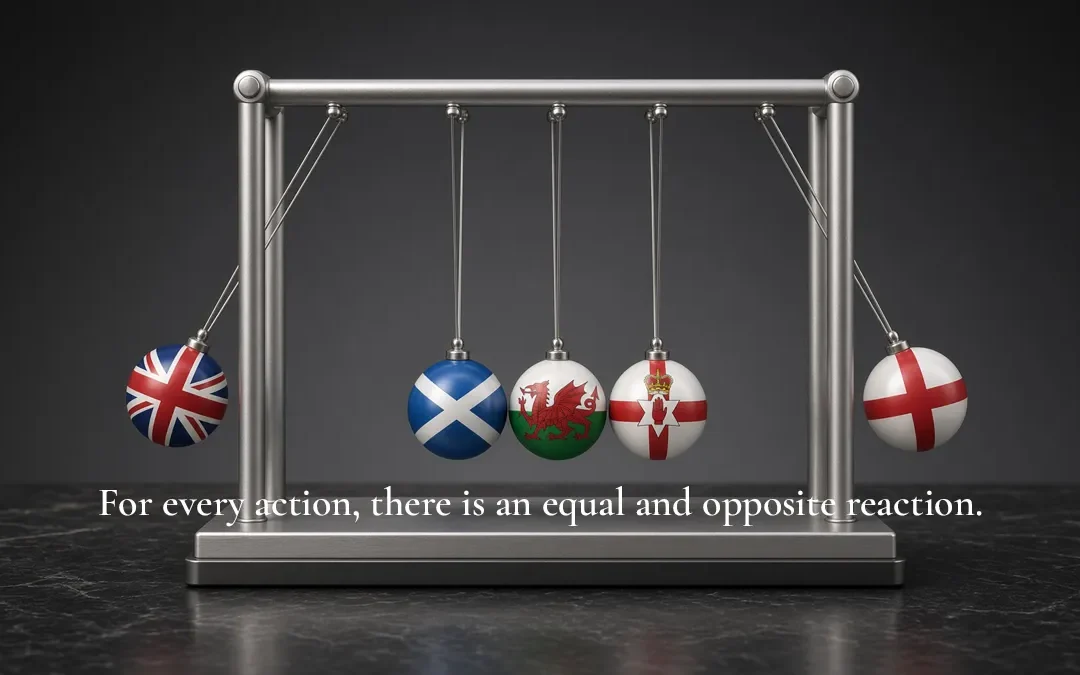
That can be valuable. British identity provides a shared identity encompassing England, Scotland, Wales and Northern Ireland and people from many different ethnic backgrounds.
But it can also have an unintended consequence.
If British becomes the inclusive civic identity available to everybody living in England while English increasingly describes only people possessing sufficient English ancestry, then Britain effectively performs the civic function that England itself might otherwise perform.
The distinction gradually becomes:
British = civic and inclusive
English = ethnic and ancestral
That is not a universally accepted distinction, but the current political argument shows that it is a real and consequential way in which the two identities are sometimes being framed.
Scotland and Wales illustrate the difficulty
Imagine telling somebody born and raised in Glasgow to Pakistani parents: “You can be British, but you cannot really be Scottish because you are not ethnically Scottish.”
Many people would immediately recognise the difficulty.
Modern Scottish identity is capable of containing both an historic Scottish ethnic and cultural inheritance and a civic Scottish nationality. The same principle can apply to Wales.
People do not necessarily have to erase their ancestry in order to acquire a national attachment to the place where they were born, raised or have made their permanent home.
Yet England has often struggled to establish the same distinction.
Because Britain provides a ready-made civic identity, people of immigrant ancestry in England have historically often identified, or been identified, as British rather than English.
The result can be paradoxical: the more successfully Britishness occupies the civic space, the easier it may become for Englishness to be discussed principally in terms of ancestry.
Badenoch’s intervention matters
Kemi Badenoch’s intervention at the 2026 Conservative Party Conference therefore goes beyond an internal party-political dispute.
Referring to politicians debating whether her mixed-race children are English, Badenoch told delegates that she did not want to explain to her son why some people might regard black players representing England as not English.
Her argument does not require the proposition that English ethnicity does not exist.
Rather, it supports a different proposition:
ethnicity need not be the sole test of English national belonging.
A person may possess Indian, Caribbean, African, Jewish, Polish or any number of other ethnic backgrounds while simultaneously developing a genuine English national identity.
The two propositions are not contradictory.
Braverman’s position raises a difficult question
Suella Braverman is entitled to describe her own identity as British rather than English. Personal identity cannot sensibly be imposed upon somebody.
The more difficult issue arises if an ancestry-based understanding is applied as a general rule governing everybody else’s English identity.
Questions immediately follow. How much ancestry is required? How many generations? Does one English parent qualify? What about one grandparent? What happens after generations of intermarriage? At what point, if ever, does a family whose ancestors arrived in England become English?
An exclusively ancestral definition ultimately requires a boundary to be drawn.
A civic national identity works differently. It can recognise ancestry and historical continuity without making ancestry the exclusive qualification for membership of the nation.
England does not need to choose between history and inclusion
There is sometimes an assumption that an inclusive English identity requires England to abandon its historical identity. That is a false choice.
A civic English identity need not mean that Englishness becomes merely an administrative description for anybody who happens to be temporarily resident within England’s borders.
National identity can involve attachment to a country’s history, institutions, customs, language, landscape and shared cultural inheritance. Integration matters precisely because nations are more than geographic locations.
Someone becoming English does not require England to become less English. It means that the national community is capable of absorbing new generations into an existing and continuing national story.
The constitutional dimension
There is another reason this matters.
England is the only nation of the United Kingdom without its own national legislature or government. Scotland possesses Scottish political institutions. Wales possesses Welsh political institutions. Northern Ireland possesses its own devolved institutions.
England is largely governed directly through UK institutions while simultaneously being divided into an expanding system of mayors, strategic authorities and devolved local structures.
That constitutional arrangement may reinforce the tendency to treat Britain as England’s civic political identity, leaving Englishness with fewer distinct civic institutions around which a modern national identity can develop.
This is part of The English Question.
It should be treated as an argument for consideration rather than a proven causal relationship. But the question deserves to be asked: if England’s principal political institutions are UK institutions, is it surprising that Britishness occupies much of England’s civic space?
A nation approaching its 1,100th anniversary
The timing of this debate is particularly striking.
In 2027 England will mark 1,100 years since the unification of England associated with King Æthelstan and the emergence of a unified Kingdom of England in 927.
That anniversary offers an opportunity to think seriously about what continuity actually means.
England’s longevity does not depend upon claiming that its population has remained ethnically unchanged for eleven centuries. Clearly it has not.
The remarkable continuity lies instead in the survival of England itself: its name, historical consciousness, institutions and laws, cultural inheritance and the continuing idea of an English people.
A national identity capable of surviving 1,100 years must necessarily be capable of absorbing change.
Englishness can be both inherited and acquired
Perhaps the argument therefore begins with rejecting a false choice.
There is an English ethnic and cultural inheritance with deep historical roots.
There is also an English civic national identity capable of including people from different ethnic backgrounds who regard England as their country.
Neither proposition invalidates the other.
Someone whose family has lived in England for many centuries does not lose their heritage because somebody of different ancestry can also identify as English.
Likewise, somebody of Asian or African ancestry does not need to pretend that their ancestry is ethnically English in order legitimately to regard England as their nation.
The danger lies in insisting that only one meaning of “English” can exist.
The English Question is also a question of belonging
The current political argument reveals something deeper about England’s unusual position within the United Kingdom.
Scotland has developed a modern civic Scottish identity alongside an historic Scottish cultural identity. Wales has done much the same. England should be capable of doing so too.
If Britishness remains the principal civic identity offered to England’s increasingly diverse population, while Englishness is progressively confined to ancestry, England risks becoming an ethnicity without a fully developed civic nationality.
That would be a peculiar destination for one of Europe’s oldest nations.
The alternative is not to erase English ethnicity or history, but to recognise that a historic nation can possess both continuity and openness.
Englishness can describe an inheritance.
It can also describe belonging.
And as England approaches its 1,100th anniversary, understanding the difference may become increasingly important.
Sources
- Politics.co.uk — Badenoch conference remarks on English identity, 7 October 2026
- The Independent — Badenoch and Braverman English identity debate, 6 October 2026
- Sky News — James Cleverly on the Englishness debate, 5 October 2026
See also: England Day 2027.