The Cardiff memorandum calls for Scotland, Wales and Ireland to determine their constitutional futures. England is absent from its account of national self-determination — even though England provides the largest share of the UK’s public revenues.
Three parties, three nations — and an unanswered English question
On 14 September 2026, the leaders of the Scottish National Party, Plaid Cymru and Sinn Féin announced a memorandum of understanding in Cardiff. John Swinney, Rhun ap Iorwerth, Mary Lou McDonald and Michelle O’Neill committed their parties to closer cooperation on constitutional change. Their message was that Westminster’s authority should no longer determine the futures of the nations they represent.
This party-political memorandum should not be confused with the separate bilateral Cardiff Agreement between the Scottish and Welsh governments. The former expresses the constitutional ambitions of political parties; it is not a new UK funding settlement or a binding intergovernmental agreement.
The memorandum speaks of Scotland, Wales and Ireland, and calls on the British Government to prepare for constitutional change. It does not propose a distinct role for England. That omission raises a question: if national self-determination is a democratic principle, does it extend to England?
Westminster is not England
The answer cannot be found simply by treating Westminster as a synonym for England. Westminster is the sovereign Parliament of the United Kingdom, while the UK Government carries out both UK-wide responsibilities and many domestic governmental responsibilities for England. Scotland, Wales and Northern Ireland have devolved national institutions; England does not have an equivalent Parliament or government.
English voters elect MPs to the UK Parliament, and English MPs form its largest contingent. England is therefore not without democratic representation. But representation within a UK institution is different from possessing a distinct English national mandate when the constitutional future of the Union is negotiated.
Who finances the Union?
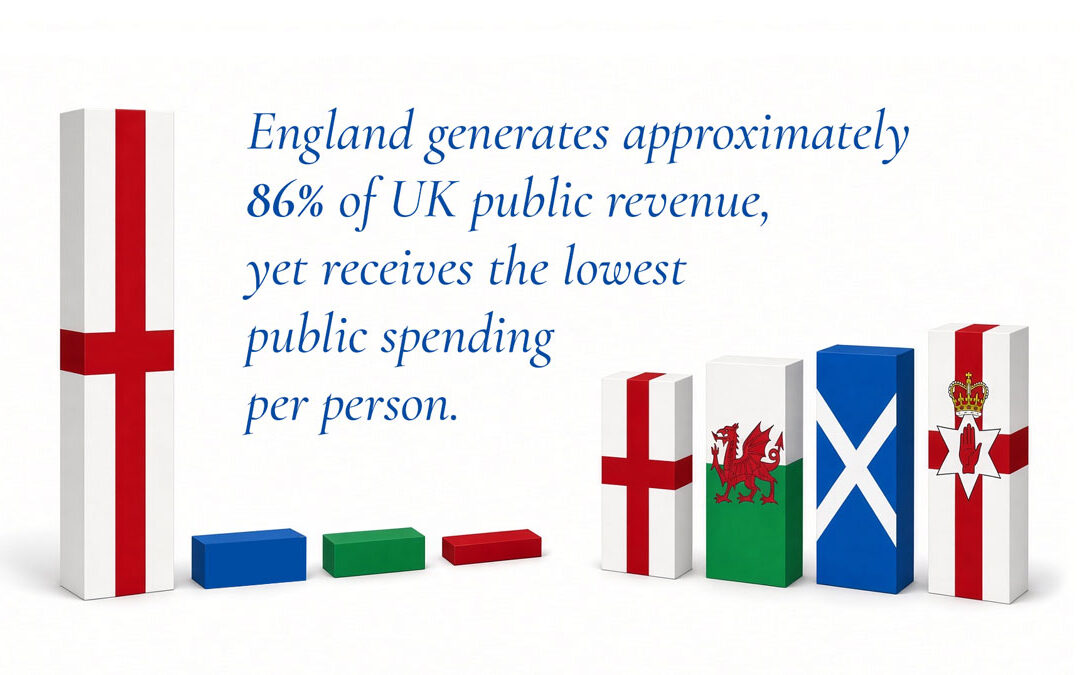
There is also a fiscal dimension. The Office for National Statistics’ country and regional public sector finances attribute the overwhelming majority of UK public revenue to England. This reflects England’s much larger population and economy, not an absence of taxation in Scotland, Wales or Northern Ireland. UK taxes and borrowing support a shared Treasury; there is no separate account into which English taxes are paid for subsequent distribution to other nations.
HM Treasury’s Country and Regional Analysis for 2024–25 estimated identifiable public spending per person at £13,134 in England, £15,563 in Scotland, £15,155 in Wales and £16,116 in Northern Ireland. These figures measure expenditure identifiable to each territory; they do not, by themselves, prove unfairness. Spending needs, demographics, geography, service costs and devolved responsibilities differ.
Nor should England be described as an unqualified fiscal surplus financing everyone else: the public sector has run deficits in England as well as elsewhere, and fiscal outcomes vary greatly between English regions. The narrower, defensible point is that England accounts for most UK tax revenue and therefore has a substantial financial stake in decisions about the Union’s future.
What exactly is being demanded of Westminster?
The memorandum urges the British Government to prepare for, plan and facilitate constitutional change. That is primarily a demand about democratic and constitutional processes, not a specified request for extra grants. The memorandum does not quantify any new spending or impose a bill on English taxpayers.
Nevertheless, any future negotiation about referendums, the transfer of powers, public debt, pensions, shared assets, fiscal transfers or the continuation of UK-wide services could have significant financial consequences. Those costs and benefits would have to be assessed openly. Because England provides the largest share of UK revenues, English residents would have a substantial interest in such decisions — just as people in the other nations would.
The missing fourth national voice
Here lies the constitutional asymmetry. The SNP, Plaid Cymru and Sinn Féin can each speak as political parties pursuing a national constitutional programme. Scotland, Wales and Northern Ireland also possess devolved national institutions. England has no comparable institution capable of adopting a distinct national position on the constitutional terms of the Union.
The UK Government can negotiate on behalf of the United Kingdom, but its dual role as England’s domestic government complicates the question of who speaks for England separately. That does not make its decisions illegitimate. It does, however, leave a gap in the architecture of four-nation constitutional negotiation.
A fair objection: these parties do not claim to represent England
Supporters of the memorandum can reasonably reply that three parties are entitled to cooperate on the futures of the nations they represent. Silence about England does not amount to opposition to English nationhood or English self-determination. Moreover, a distinct English Parliament is not the only possible democratic arrangement: federalism, regional devolution, a constitutional convention or the existing UK parliamentary system could all be debated.
The case for an English national voice must therefore be made positively, not by assuming hostility on the part of the signatories. The test is whether they would affirm for England the democratic principle they invoke for their own nations.
Three questions for the signatories
- Principle: Do you recognise England as a nation whose people have the right to determine their own constitutional future?
- Representation: Should England have a distinct democratic mechanism through which to express its national constitutional preferences?
- Negotiation: If the United Kingdom’s constitutional and financial arrangements are renegotiated, should England be represented as a nation separately from the UK Government?
Who speaks — and who pays?
The Cardiff memorandum is an invitation to reconsider the constitutional future of these islands. England should be part of that conversation, not treated as interchangeable with the government at Westminster. The economic question reinforces the democratic one: those affected by the fiscal consequences of constitutional change deserve transparent accounting and an effective voice.
England need not demand a veto over other nations’ democratic choices to insist that its own constitutional interests be recognised. If the future is to be built on nations cooperating as equals, the missing fourth nation cannot remain an afterthought.
Sources and further reading
- Sinn Féin: full memorandum and announcement, 14 September 2026
- Office for National Statistics: Country and regional public sector finances, financial year ending 2025
- HM Treasury: Country and Regional Analysis, November 2025
- House of Commons Library: Public spending by country and region
Further reading from Englandism: The English Question | What Is Englandism? | News & Commentary.