Celebration is not the same as recognition
England’s flag, literature, sport, history and traditions are familiar features of British public life. English cultural identity can be acknowledged without changing who exercises political power. But recognising England as a distinct political nation raises a more difficult question: should England, like Scotland, Wales and Northern Ireland, have a dedicated national forum for deciding its domestic affairs?
The distinction is fundamental. Celebrating a nation costs Westminster little constitutional authority. Establishing an English parliament or government would require a substantial reconsideration of where that authority resides.
England’s constitutional anomaly
Scotland has a Parliament and Government, Wales has the Senedd and Welsh Government, and Northern Ireland has an Assembly and Executive. England has no equivalent national legislature or executive. Instead, UK ministers and Westminster institutions perform England-wide governing functions alongside their responsibilities for the Union.
This does not mean England lacks political influence: its population and MPs form the great majority of the United Kingdom. It means that England’s national political interests are not articulated through a separately accountable national institution. As former minister and academic John Denham told a parliamentary committee, English Votes for English Laws did not create a national forum in which England’s future could be debated (House of Lords oral evidence).
The clearest evidence: Westminster’s fear of a rival centre of power
There is unusually explicit institutional evidence that an English parliament is viewed as a threat to the existing constitutional balance. In its 2022 report Respect and Co-operation: Building a Stronger Union for the 21st Century, the House of Lords Constitution Committee argued that creating an English parliament would make England’s population and economic dominance more visible relative to the devolved nations and would destabilise the Union (House of Lords Constitution Committee, paragraph 230).
This was not an admission of hostility to English identity. It was a direct statement that separate English national institutions could threaten the Union’s governing architecture.
The institutional implications are substantial. A separately elected English parliament and government could claim their own democratic mandate over matters currently handled by UK departments. England’s size would make its executive an unusually powerful counterpart to the UK Government. Disputes over spending, legislation, taxation and political legitimacy could therefore become conflicts between two centres of authority rather than debates inside Westminster.
That concern is a serious constitutional argument. But it also reveals the trade-off: preserving the present structure of British government may take priority over creating national institutions for England.
English Votes for English Laws: recognition granted and withdrawn
In 2015, Westminster introduced English Votes for English Laws (EVEL), giving MPs from affected constituencies an additional consent role in specified legislation. The reform did not establish an English parliament or government, and a House of Lords committee concluded that it fell short of the broader agenda-setting powers enjoyed by devolved legislatures (Constitution Committee, 2016).
In July 2021, the House of Commons abolished EVEL. Ministers cited procedural complexity and the need for Parliament to function as a UK-wide institution (Hansard, 12 July 2021).
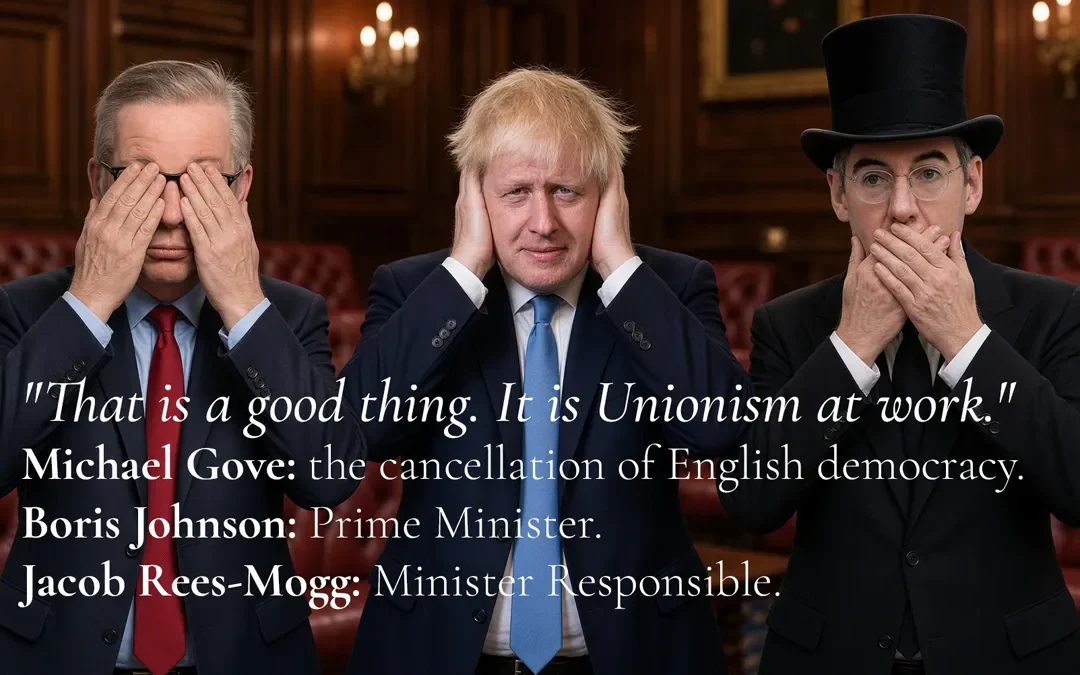
Michael Gove subsequently explained to the House of Lords Constitution Committee that EVEL had failed to strengthen the Union and argued that English voters and MPs should demonstrate a spirit of generosity towards it. This is direct evidence of a unionist rationale for withdrawing a limited form of distinct English parliamentary recognition (House of Lords Constitution Committee, paragraphs 149–155).
Critics of EVEL also raised genuine procedural objections: the arrangements were complicated, and their operation did not amount to coherent government for England. Its abolition therefore cannot, by itself, establish a policy of suppressing English identity.
Why regional devolution is not national recognition
Successive governments have pursued decentralisation through councils, combined authorities and elected mayors. Such reforms can bring decisions closer to communities and provide meaningful local accountability. But they do not create an England-wide democratic institution able to formulate a national programme for England.
Regional devolution also leaves the centre of UK government intact. Authority is transferred to particular places and functions, rather than to a separate national government representing England as a whole. The effect is to permit decentralisation without establishing a rival English executive.
That distinction does not prove that regional devolution was designed to weaken English national identity. Its supporters can reasonably argue that a single English parliament would reproduce centralisation at a different level. Nevertheless, the chosen model avoids precisely the institutional rivalry that the House of Lords identified as a danger to the Union.
Is this anti-English bias, or constitutional self-preservation?
The evidence supports a narrower and more persuasive conclusion than the claim that British institutions oppose everything English. Englishness is openly celebrated in many cultural and civic settings. What encounters resistance is the proposal to translate English nationhood into a separate source of democratic authority.
Professor John Denham has argued that the Westminster model and its centralising habits inhibit effective English devolution. His analysis identifies institutional incentives and a political culture that commonly treats British and English governance as interchangeable (Denham, Centralised by Design, 2025).
There is a plausible institutional explanation: UK-wide political parties, ministers and departments have limited incentive to create an English body that could compete for responsibilities, public attention and democratic legitimacy. But this remains an inference about incentives, not documentary proof of a coordinated anti-English programme.
The counterargument: would an English parliament weaken the Union?
Opponents of an English parliament point to England’s overwhelming share of the UK’s population and economy. A powerful English government could overshadow the smaller devolved administrations, complicate fiscal relations and challenge the authority of the UK Prime Minister. There is also no single agreed model for an English parliament: questions remain over its powers, electoral system, relationship to Westminster and treatment of English regional interests.
Those concerns deserve consideration. But they also expose a constitutional tension. If England’s size is a reason not to give it national institutions, England’s national political recognition becomes constrained precisely because it is the largest nation in the Union.
From England’s history to England’s future
The approaching 1,100th anniversary of England’s unification under King Æthelstan in 927 offers a useful test of this distinction. Historical commemoration is not a demand for independence, nor does it require endorsement of any particular constitutional reform. England’s history belongs to people of varied backgrounds and political beliefs.
Yet the anniversary invites a broader question: is England to be recognised principally as a historic and cultural community, or also as a political nation entitled to an explicit democratic voice within the United Kingdom?
A decision not to hold a particular commemoration would not alone prove institutional bias. Such a claim would require evidence about official reasoning, comparable anniversaries, budgets and policy priorities. But the anniversary is an opportunity to examine whether public celebration and political recognition are treated differently.
Conclusion: the difference between honouring England and empowering it
British political institutions have accommodated English cultural identity while preserving constitutional arrangements that limit its expression through distinct national institutions. Parliamentary evidence shows that concern for the Union has been an explicit reason for resisting or withdrawing some forms of English institutional recognition.
This does not establish a coordinated campaign against Englishness. It does, however, justify asking whether the British state’s commitment to its existing constitutional structure has repeatedly taken precedence over giving England a distinct political voice.
England can be celebrated without changing who governs it. Recognising England as a political nation raises the harder question of who should exercise power in its name.
Further reading: The English Question · England in 927 · England 1100 · England Day 2027.