England, devolution and consent
Was English regional devolution voted for?
England was not asked. Scotland, Wales and Northern Ireland were. The UK Government is rolling out Strategic Authorities across England without the founding referendum the other three nations received — and without ever offering a vote on an English Parliament.
Direct answer
Was English regional devolution voted for? Not by England. Council leaders agreed deals; Parliament passed Acts. The only English regional-assembly referendum, in the North East in 2004, was lost.
England has never been permitted a referendum on an English Parliament to represent English interests. The present map of metro and county mayors is therefore a product of government direction, not of English popular consent comparable to 1997–98 in the other three nations.
Key facts at a glance
- Scotland, 11 September 1997: referendum on a Scottish Parliament (Yes 74.3%) and tax-varying powers (Yes 63.5%).
- Wales, 18 September 1997: referendum on a National Assembly (Yes 50.3%).
- Northern Ireland, 22 May 1998: referendum on the Belfast/Good Friday Agreement, including the Assembly (Yes 71.1% in NI).
- England, 4 November 2004: referendum on an elected North East regional assembly — No 77.9% on a 47.7% turnout. No further English regional-assembly referendum was held.
- England as a whole: no referendum on an English Parliament; no referendum on mayoral combined authorities; no referendum on the 2024 white paper or the English Devolution and Community Empowerment Act 2026.
- 2016 onwards: metro mayors created by statutory instrument after deals with council leaders, not after public votes.
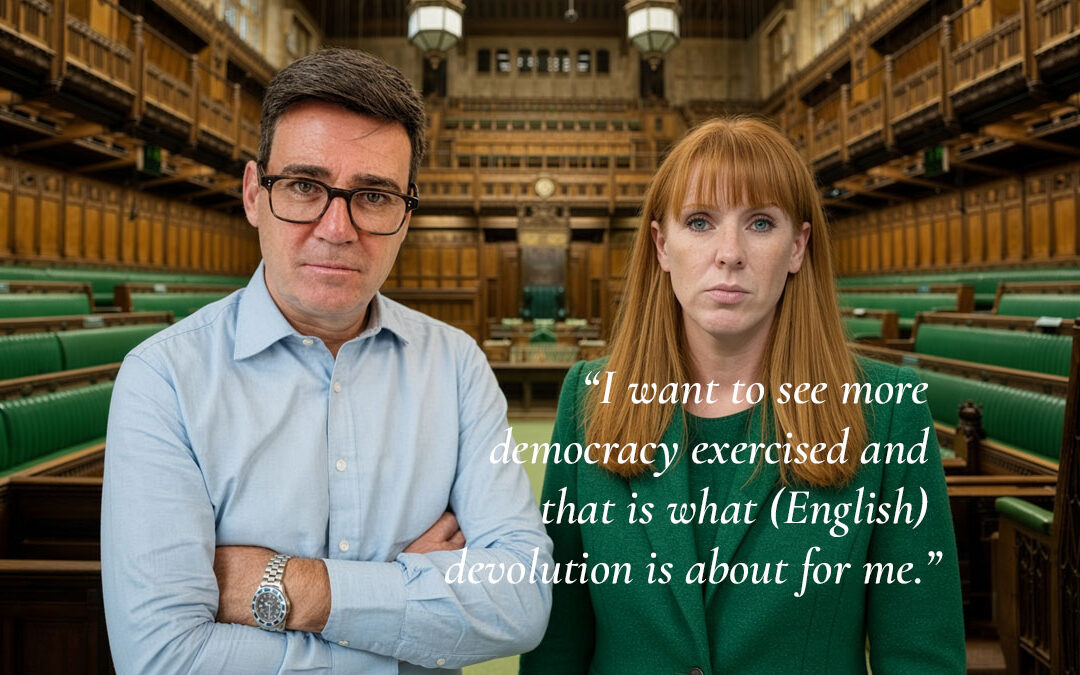
- From 20 July 2026: Prime Minister Andy Burnham and Housing Secretary Angela Rayner direct the next stage from the UK Government. That is Westminster control in England, not an English national government.
The other three nations were asked
The late-1990s settlement is often called “the devolutionary settlement of the United Kingdom.” That wording hides an asymmetry of consent.
Scotland and Wales were given referendums before their legislatures sat. Northern Ireland voted on the 1998 Agreement as a package, including power-sharing institutions. Those votes are why Holyrood, the Senedd and Stormont can claim a popular founding mandate — however contested later politics became.
Wales was asked again in 2011 about full law-making powers (Yes 63.5%). Scotland was asked in 2014 about independence (No 55.3%). In both cases the UK Government accepted that the nation’s public was the right electorate for a constitutional step.
England was not placed in that category.
The one time England was asked, England said no
The only binding popular vote on a new English regional tier was the North East England devolution referendum on 4 November 2004. Electors were asked whether they wanted an elected assembly for the North East. They did not.
Official result: 696,519 No (77.9%); 197,310 Yes (22.1%); turnout 47.8%. Every counting area voted No.
That result ended the programme of elected regional assemblies. It was not treated as a veto on dividing England by other means. Regional Development Agencies continued until 2012. From 2011 a different architecture — combined authorities and directly elected “metro” mayors — was built without putting the principle back to English voters.
In May 2012, ten English cities were asked, under a different law, whether they wanted a local authority mayor. Nine voted No. Bristol voted Yes. Those results also failed to stop the later imposition of combined-authority mayors as a condition of deals with council leaders.
How England is being divided without a founding vote
English regional devolution does not use England as the unit. It uses city-regions and county groups. The legal name from 2024–26 is Strategic Authority: Foundation (no mayor), Mayoral, or Established Mayoral.
That map is assembled as follows:
- Ministerial offer. Powers and money are offered if councils form a combined authority and, in most cases, accept a mayor.
- Leader consent, not public consent. The “yes” that counts is the constituent councils, not a referendum of residents.
- Order in Council / statutory instrument. The Secretary of State creates the body. The Cities and Local Government Devolution Act 2016 made a public referendum unnecessary.
- Act of Parliament. The English Devolution and Community Empowerment Act 2026 (Royal Assent 29 April 2026) puts the Strategic Authority ladder into statute and ties it to unitary reorganisation of two-tier England.
Each step can involve consultation papers, deal documents and council debates. That is administrative process. It is not equivalent to the 1997 Scottish question: should this nation have its own parliament?
A later mayoral election chooses a person for a post that already exists. It does not ratify the absence of an English Parliament, nor the choice to govern England as a set of regions while Scotland, Wales and Northern Ireland are treated as nations.
No referendum on an English Parliament has been permitted
Campaigns for an English Parliament have existed since the 1990s. Westminster has never put the question to English electors.
What England received instead were parliamentary devices and administrative tiers:
- No English first minister, no English legislature, no English block grant in the 1998–99 statutes that created the other three institutions.
- English votes for English laws (EVEL), 2015–2021 — a Commons standing-order experiment, not a referendum; later abolished.
- Metro mayors and Strategic Authorities — a delivery tier for transport, skills, housing and growth funds, still created and financed by the UK Government.
The constitutional claim is simple. If a Scottish Parliament required a Scottish Yes, an English Parliament would require an English Yes — or at least an English chance to say No. That chance has not been given. The substitute is to slice England into mayoral areas until the nation is covered, then call the coverage “devolution.”
Coverage of a map is not consent to the map.
Who directs the next stage
Because there is no English founding vote, the next change does not go back to the English public as a public. It goes to the Prime Minister and the Secretary of State for Housing, Communities and Local Government.
Since 20 July 2026 those offices are held by Andy Burnham (Prime Minister; former Mayor of Greater Manchester) and Angela Rayner (Housing, Communities and Local Government Secretary; MP for Ashton-under-Lyne; Housing Secretary 2024–25 when the white paper was published). Both are Greater Manchester Labour politicians. They know the mayoral model from the inside. They now write its rules from the UK cabinet.
That pairing can deepen Integrated Settlements, push unitary councils, add a tax slice, or pause a local map — all without an English referendum. Mayors sit on a Mayoral Council with ministers. They do not form an English government. The UK cabinet remains the government of England.
Why mayors are not an English voice like the other three governments
| Test | Scotland, Wales, Northern Ireland | English Strategic Authorities |
|---|---|---|
| Founding public vote | Yes (1997 / 1998) | No (2004 North East voted against a regional assembly) |
| National legislature | Yes | No |
| Can pass primary law in a national field | Yes, within the devolution statutes | No; powers are conferred by UK order and Act |
| Unit of identity | The nation | A city-region or county group |
| Who can redesign the system | Politically constrained by the founding vote | The UK Government, now via No.10 and MHCLG |
Holyrood is not “regional policy.” A Mayor of the East Midlands or Cumbria is regional policy with a ballot paper attached. Treating the second as the English equivalent of the first erases the missing referendum on England itself.
FAQ
Was English regional devolution voted for?
Not by England. Council leaders agreed deals; Parliament passed Acts. The only English regional-assembly referendum, in the North East in 2004, was lost.
Has England ever been offered a referendum on an English Parliament?
No. Successive UK governments have not put that question to English electors. There has been no equivalent of the 1997 Scottish or Welsh referendums for England as a nation.
Did council deals provide democratic consent?
They provided institutional consent from local authorities that wanted funds and transport powers. That is not a vote of the English people on how England should be governed relative to Scotland, Wales and Northern Ireland.
Do mayoral elections fix the consent gap?
No. Those elections choose a mayor after the office has been created. They do not authorise the division of England into Strategic Authorities, and they do not substitute for a referendum on an English Parliament.
Who holds the system now?
The Prime Minister and the Secretary of State for Housing, Communities and Local Government. As of 20 July 2026 that is Andy Burnham and Angela Rayner. The UK Government retains the legal power to create, fund, grade and amend English devolution. That is absolute control in England in the sense that no English national institution stands between the cabinet and the map.