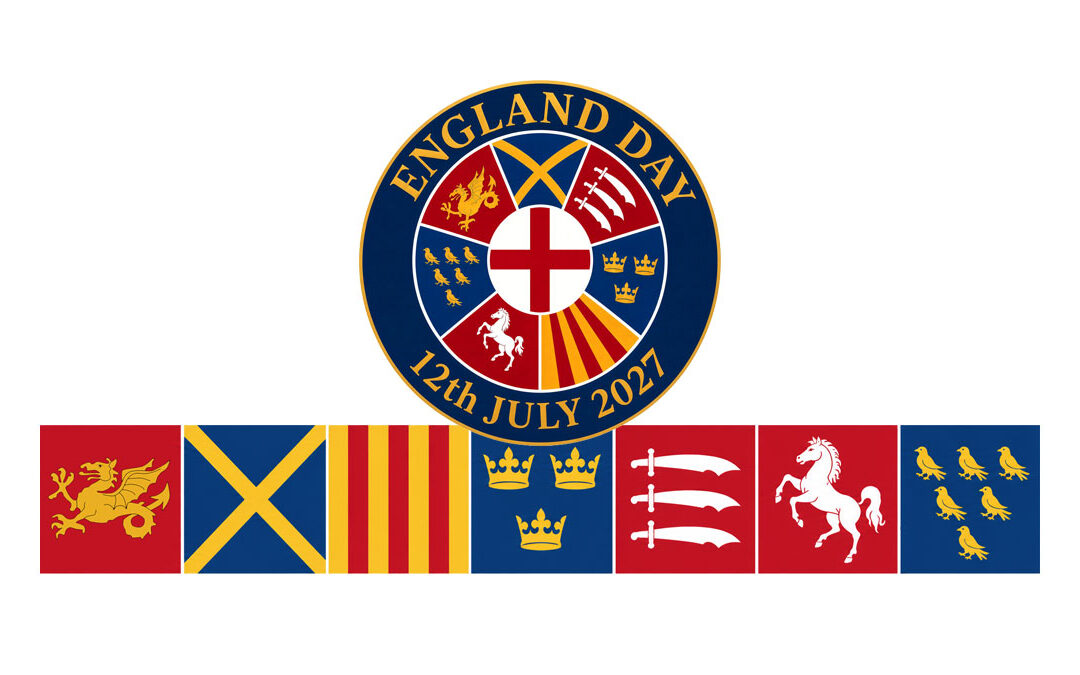
Direct answer: England Day is the name Englandism gives to Monday 12 July 2027, the 1,100th anniversary of England’s unification under King Æthelstan at Eamont Bridge on 12 July 927. The aim of Englandism is that England Day should be an English bank holiday.
What this article covers
- What England Day 2027 is
- Why the date is 12 July, and why the year is 927
- Why a bank holiday is the aim, rather than a festival programme
- How England Day differs from St George’s Day and from 1066 commemorations
What is England Day 2027?
England Day 2027 is Monday 12 July 2027. Englandism uses that Monday as the civic anniversary of England becoming one kingdom under Æthelstan in 927. One thousand one hundred years later, the aim of Englandism is an English bank holiday on that day.
England Day is a date on the calendar, not a membership test. Anyone who wants to mark the foundation of the English kingdom can keep it. The campaign’s stated purpose is the holiday itself.
Why is the date 12 July 927?
The date is 12 July 927 because that is when Æthelstan of Wessex is recorded as having secured recognition as king of the English at Eamont Bridge, south of Penrith in Cumbria, after Northumbria had come under his rule. From that meeting England is treated as one realm under one king, Rex Anglorum.
- Wessex first: The West Saxon kingdom provided the kingship that later covered all England.
- Alfred’s survival: Alfred’s stand in 878 kept an English realm intact enough to be unified later.
- Æthelstan in 927: The Eamont Bridge assembly is the moment Englandism uses as unification.
- 2027: 12 July 2027 is a Monday, 1,100 years on. That Monday is the proposed English bank holiday.
Eamont Bridge is a real place beside the M6, not a myth-site invented for the anniversary. England Day points at that place and that year.
Why a bank holiday and not another kind of commemoration?
A bank holiday is a public date. Schools and many workplaces close; the day appears on calendars; nobody has to decode a campaign slogan to know that something is being marked. Englandism treats an English bank holiday on 12 July 2027 as the clearest civic form of England Day.
- Visible: A holiday is harder to overlook than a webpage or a local event listing.
- Shared: People can spend the day however they wish. The aim is the day off, not a script.
- Limited: The campaign ask stops at the English bank holiday. It does not require a new institution to exist first.
How does England Day differ from St George’s Day and from 1066?
| Date | What it marks | Public status in England |
|---|---|---|
| 23 April — St George’s Day | England’s patron saint | Not a bank holiday |
| 14 October 1066 — Hastings | Norman conquest of an existing kingdom | Remembered as a battle, not kept as a national holiday |
| 12 July 927 — Eamont Bridge | Unification under Æthelstan; foundation of one English kingdom | Not a bank holiday. England Day 2027 is the proposal to change that for the 1,100th anniversary |
St George’s Day is a saint’s day. 1066 is a conquest of a kingdom that already existed. England Day is tied to the unification date. Those three stories can sit on the same calendar without replacing each other. The only new public instrument Englandism asks for is the 2027 English bank holiday.
Key facts at a glance
- England Day: 12 July 2027
- Anniversary: 1,100 years since 12 July 927
- Place of the 927 meeting: Eamont Bridge, Cumbria
- King: Æthelstan of Wessex, King of the English
- Aim of Englandism: an English bank holiday on England Day
What would an England Day bank holiday actually mean?
An English bank holiday on 12 July 2027 would mean a statutory public holiday in England on that Monday. It would not tell people what to display, where to stand, or which version of English history to recite. It would put the 927 anniversary on the same kind of footing other countries give their foundation or national days: a shared day off.
Until that holiday exists, England Day is still the date. Households, parishes, pubs and counties can mark 12 July 2027 without waiting. The campaign aim remains the English bank holiday.
Frequently asked questions
What is England Day?
England Day is 12 July 2027, the 1,100th anniversary of England’s unification under Æthelstan. Englandism wants that date kept as an English bank holiday.
What is the aim of Englandism?
The aim of Englandism is an English bank holiday on 12 July 2027.
Is England Day the same as St George’s Day?
No. St George’s Day is 23 April. England Day is 12 July, tied to the 927 unification, not to the patron saint.
Why not use 1066 as the national date?
1066 changed who ruled England. It did not found England. The kingdom already existed. England Day uses the unification date of 927.
Where is Eamont Bridge?
Eamont Bridge is a village south of Penrith in Cumbria, just off the M6. The 927 meeting of rulers is associated with that place.
Does England Day require anyone to prove they are English?
No. A bank holiday is a public date. Englandism’s aim is the holiday, not a test of ancestry.
Summary
England Day is Monday 12 July 2027: 1,100 years after Æthelstan’s unification of England at Eamont Bridge on 12 July 927. The aim of Englandism is that England Day should be an English bank holiday. That is the whole of the public request.